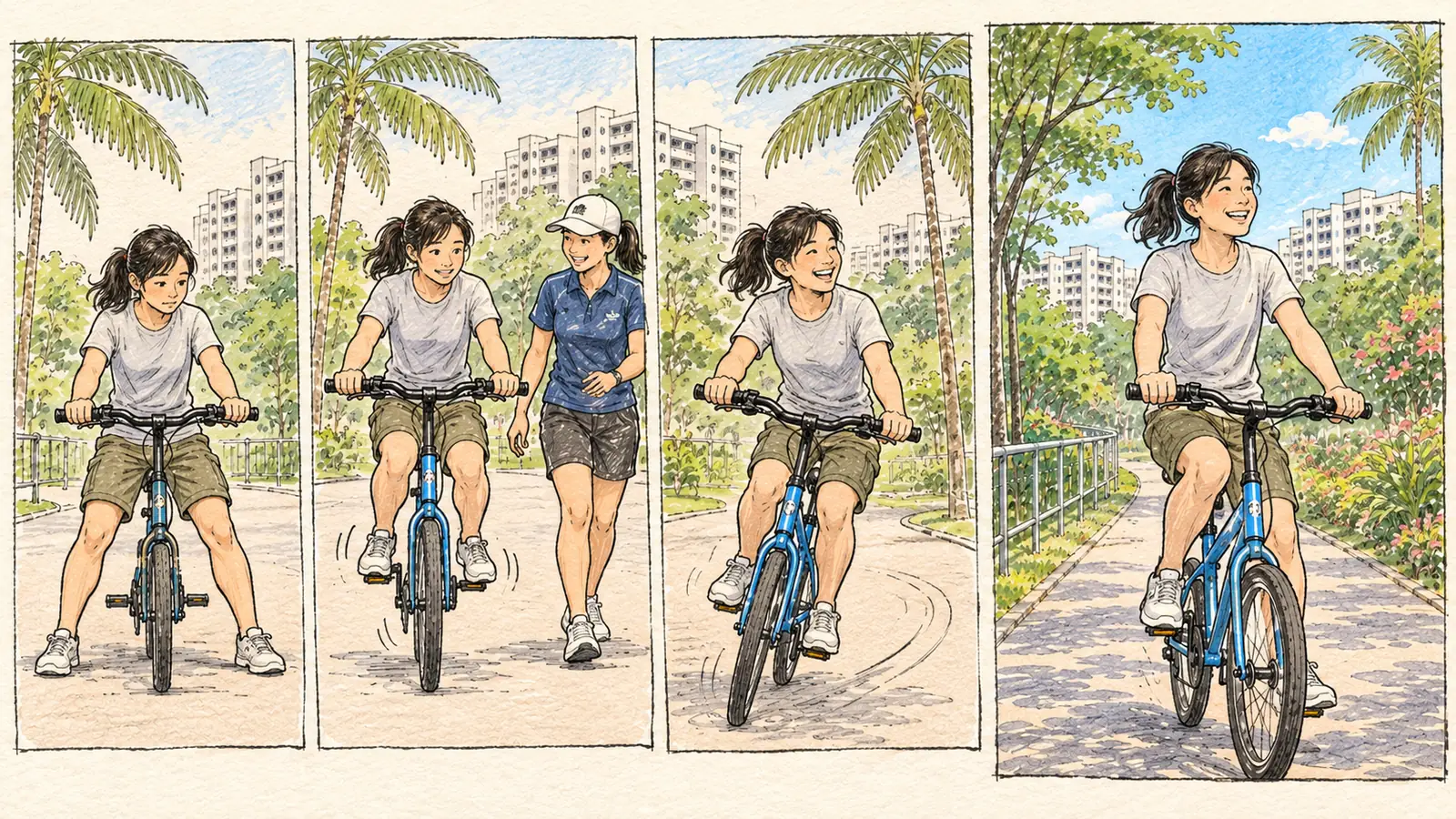
The short answer: with a coach, most adults are balancing on their own by the end of the first 60-minute lesson, and feel comfortable steering, braking and riding on a quiet path within 1 to 4 lessons. Teaching yourself usually takes longer, and how long varies a lot.
That's the headline. The useful part is what actually decides whether you're a one-lesson person or a four-lesson person, and what you can do to speed things up.
A realistic timeline
Here's what the journey usually looks like for an adult who has never ridden before. Everyone moves at their own pace, so treat it as a map, not a deadline.
Lesson 1: balancing and gliding
Seat low, pedals off or ignored, feet on the ground. You learn to scoot, lift your feet, and glide. For many adults, this is the "wait, I'm actually doing it" moment. By the end, most people are balancing on their own and starting to pedal, though turns can still be wobbly.
Lessons 2–3: steering, braking and control
Now it's about control: pedalling smoothly, steering in a line, turning without panicking, and braking without grabbing. This is where the confidence starts to feel real instead of borrowed.
Lesson 4: the real world
Gentle slopes, wider turns, starting and stopping, and riding alongside other people. This is the lesson that turns "I can ride" into "I can go out and ride".
After that: hours in the saddle
The rest is practice. A park connector near you is a perfect place for it. Our guide to learning cycling as an adult in Singapore has the best places to start. Wondering what 1–4 lessons adds up to? See how much cycling lessons cost in Singapore.
What speeds you up (and what slows you down)
The physical skill is the same at 6 and at 36. The differences between learners come down to a handful of things.
Fear of falling is the biggest factor
When you're bracing for a fall, your arms stiffen, your shoulders rise and your eyes lock onto the ground. All three make the bike wobble more, which confirms the fear. Adults who feel safe, stay relaxed and keep their eyes up often progress faster than adults who are naturally more athletic but tense.
The setup matters more than people think
- Seat too high. You can't reach the ground, so you can't catch yourself, and that makes everything scarier. Start with both feet flat on the floor.
- Wrong bike size. Too big is the usual problem. Check our first-lesson guide for what to bring and how to size up.
- Pedals on too early. Balance first, pedalling second. Skipping this step is why many people "tried and couldn't".
- A bumpy or sloped surface. A flat, smooth, quiet spot takes away half the difficulty.
How you practise
Short and regular beats long and rare. Two or three sessions of 20–30 minutes a week on a flat, quiet surface is plenty. A long break between sessions means starting from a shakier place each time.
Whether someone is correcting you
Without feedback, you can repeat the same small mistake for weeks without knowing what it is. A coach spots it in seconds: looking down, gripping too hard, setting off with the wrong foot. That alone is why coached learners tend to get there in fewer sessions.
The bike doesn't know how old you are. What slows adults down isn't age, it's tension.
How long does it take on your own?
There's no honest single number. Some people who rode as children and are just rusty are riding again within a few evenings. People starting from zero, or who are nervous, can spend weeks of on-and-off practice, and some give up before they get there. If you want to compare the options, we break it down in self-learn vs group class vs private lesson.
How to know you've "learned"
A useful checklist, rather than a number of hours:
- You can push off and start without wobbling badly.
- You can brake smoothly and stop with a foot down, without panic.
- You can make a gentle turn and ride in a straight line.
- You can look over your shoulder, or ride past someone, without freezing.
- You feel relaxed enough to enjoy it.
Tick most of these and you've learned to cycle. The rest is building confidence, and that comes with riding.
Common questions
Do adults learn slower than children?
Not because of the physical skill. Balance is learned the same way at any age. Adults take longer mainly because of fear of falling and tension, which a patient coach can work on directly.
Can I learn to cycle in one day?
Many adults ride on their own by the end of the first lesson. Becoming confident enough for turns, braking and riding around other people usually takes a few more sessions and some practice in between.
How often should I practise between lessons?
Two or three sessions of 20–30 minutes a week on a flat, quiet surface is plenty. Short and regular keeps the skill fresh.
What if I tried before and couldn't do it?
That's very common and rarely a sign you can't learn. The usual causes are a seat set too high, a bike that's the wrong size, pedals on too early, or a bumpy surface. Starting again with the seat low on a flat, quiet spot usually changes the result.