If the thought of getting on a bike makes your stomach drop, you're in good company. Fear of falling is the most common thing we hear from adult beginners, far more common than "I'm not fit enough" or "I'm too old".
In Singapore, it's a very common story. Many of us grew up in HDB flats with nowhere to ride, parents who worried about the roads, or a bike that was promised "next time" and never came. Then one day your friends suggest renting bikes at East Coast Park, and you quietly volunteer to hold the bags and take photos instead.
Here's the good news: the fear isn't a sign you can't learn. It's a normal reaction to something new and wobbly, and it can be worked on in a step-by-step way. This guide covers why fear makes cycling harder, what falling at beginner speed actually looks like, and how to set things up so you feel safe from the very first minute.
Why fear makes the bike wobble more
When you're bracing for a fall, your body does three things: your arms stiffen, your grip tightens, and your eyes drop to the ground just in front of the wheel. Each of these makes the bike harder to balance. Stiff arms over-steer, a tight grip passes every twitch to the handlebars, and looking down means you react late.
So the bike wobbles more, which seems to prove the fear was right, and the cycle repeats. That's why the fix isn't to "be brave". It's to make the situation feel safe enough that you can relax, and then the balance comes much more easily.
What falling actually looks like at beginner speed
Most people picture a dramatic crash. That's not what happens in a beginner lesson.
- You're moving at walking pace or slower. Early practice is about gliding, not speed.
- Your feet can reach the ground. With the seat set low, a wobble almost always ends with you putting a foot down, not toppling over.
- The bike tips slowly. At low speed you have time to step off. Most "falls" are really a stumble and a laugh.
We won't pretend tumbles never happen. Once in a while a beginner loses balance and goes down. That's why we suggest thick jeans or sturdy long pants and closed-toe shoes. They turn a tumble into something you brush off, not a graze you nurse for a week.
Set up so falling is hard to do
Most of the fear comes from a bad setup, not from cycling itself. Get these right before you even try to ride.
- Lower the seat until both feet are flat on the ground. This is the single biggest confidence boost. If you can always put your feet down, you can always stop.
- Pick a flat, smooth, quiet spot. A sheltered HDB carpark mid-week or a quiet corner of a park is ideal. No slopes, no crowds, no cars.
- Beat the heat. Practising at 1pm under the sun is tiring, and tired, sweaty hands grip harder. Go in the morning or early evening, or stay under shelter, and bring water.
- Use a bike that fits you. A bike that's too big is much scarier to handle. Our first-lesson guide covers what to bring.
- Wear what makes you feel safe. Thick jeans and closed-toe shoes are the essentials. A helmet, gloves or knee pads aren't required on a flat practice surface, but if they help you relax, wear them. Feeling safe is the whole point.
- Leave the audience at home. Being watched adds pressure, and pressure adds tension. Pick a time when the void deck is quiet, not when the uncles are playing chess and the kids are zooming around on scooters.
Five small steps that build trust
The trick is to never ask yourself to do something scary. Each step should feel only slightly harder than the last. Stay on a step until it feels boring, then move on.
1. Walk the bike and practise braking
Stand beside the bike, walk it along and squeeze both brakes gently to stop. Do this until you trust the brakes. Knowing you can stop is half the battle.
2. Sit and scoot
Sit on the seat with both feet on the ground and walk the bike forward like a balance bike. No pedalling. Get used to the bike moving under you while your feet stay in control.
3. Glide with your feet up
Push off with both feet and lift them just off the ground for a second or two. Then put them down. Gradually stretch the glide. This is where balance actually happens, and it's usually the moment people realise they can do it.
4. Look ahead, not down
Pick a spot 5 to 10 metres in front of you and keep your eyes there. The bike goes where you look. Looking up feels scary at first, but it's what makes the bike steady.
5. Add the pedals
Only once gliding feels easy. Put one pedal at about two o'clock, push down on it to start, and keep gliding as you find the other pedal. If it gets wobbly, stop pedalling and put your feet down. You know how to do that already.
You don't need to stop being scared before you start. You need each step to be small enough that the fear has time to fade.
What a good coach does about fear
A lot of adults put off learning because the last person who taught them let go too early, or shouted "just pedal!" at them. Good coaching for nervous learners looks very different.
- You set the pace. Nobody pushes you to the next step until you're ready.
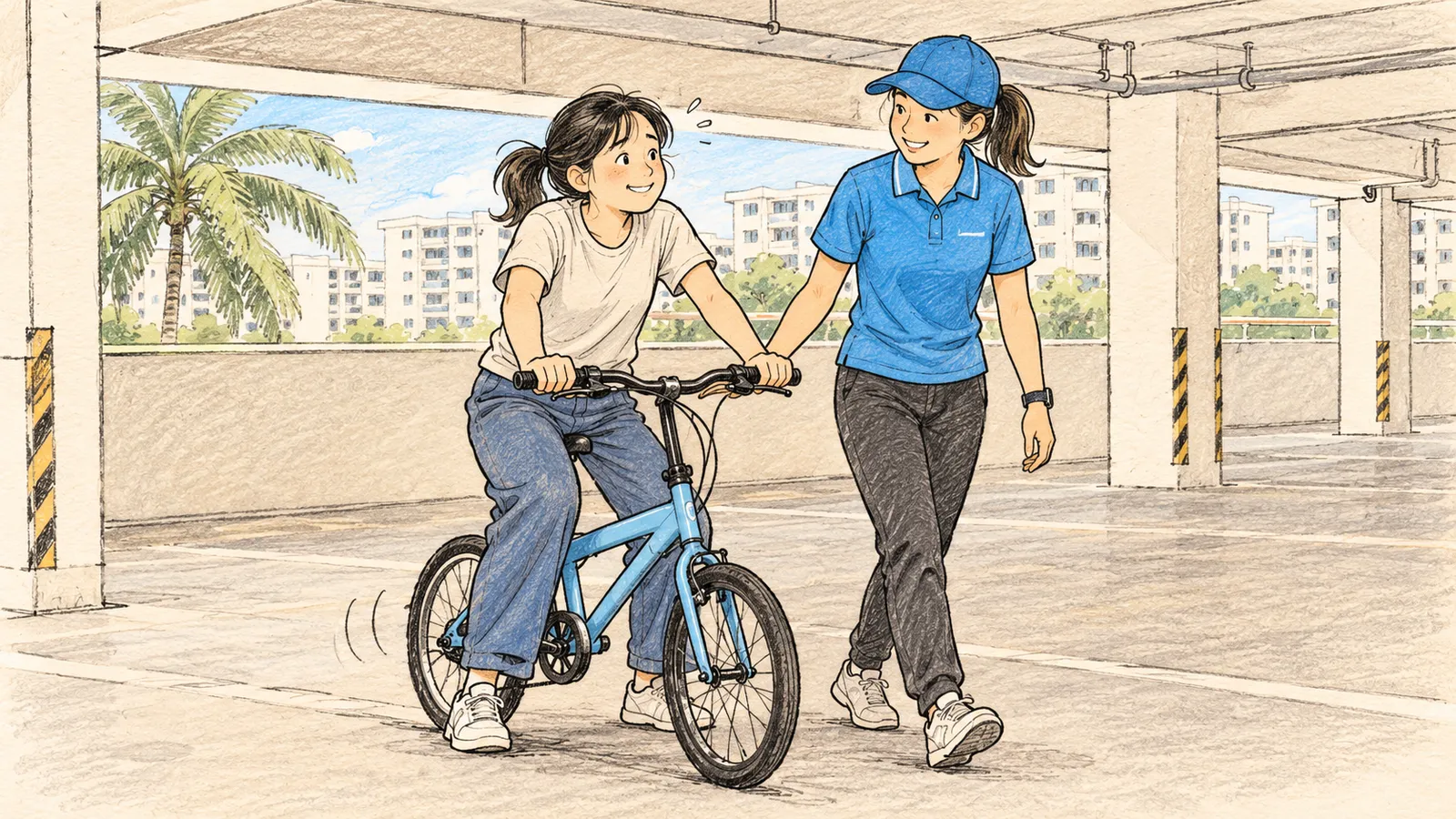
- The coach walks right beside you. A hand stays close to the back of the seat or your shoulder, ready to steady you, without gripping so tightly that you never feel the balance yourself.
- No surprise let-gos. You'll know when you're riding on your own, because you'll agree on it first.
- Small mistakes get caught early. Looking down, gripping too hard, setting off with the wrong pedal. A coach spots these in seconds, before they turn into wobbles that shake your confidence.
That's also why most nervous adults find a 1-on-1 lesson easier than a group class: nobody's watching, and nobody's waiting for you. We compare the options in self-learn vs group class vs private lesson.
"I fell badly as a kid"
This is one of the most common stories behind adults who never learned. A fall at seven, a bike that was too big, someone letting go without warning, and the memory stuck.
None of that was your fault, and it doesn't predict how it will go now. Starting again with the seat low, on a flat surface, at your own pace, usually feels completely different from what you remember. Our guide to learning cycling as an adult in Singapore has more on starting over.
Feeling paiseh about learning as an adult?
A lot of adults tell us the fall isn't actually the scariest part. It's the thought of someone seeing them wobble. A kid cycles past without holding the handlebars, and suddenly you want to disappear.
Honestly, nobody is watching as closely as you think. And the people who do notice are usually impressed, not judging. Learning something new as an adult takes more courage than learning it at six. If it helps, start somewhere private, like a quiet carpark on a weekday morning, and only head to the park connector once you feel steady.
The next fear: sharing the park connector
Once you can ride, a new worry often appears: joggers, dog walkers, other cyclists ringing their bells and PMDs coming up behind you. That's normal too, and it gets easier quickly with a few habits:
- Start on quiet stretches at off-peak times. Weekday mornings are much calmer than a Sunday afternoon at East Coast.
- Keep left and ride slowly. There's no minimum speed. Faster riders will pass you.
- Stop when unsure. Stopping with a foot down is always allowed, and it's the skill you practised first.
- Get off and push through crowded spots. Nobody minds, and it's what experienced riders do too.
Not sure where to start? Our adult beginner's guide lists some flat, quiet spots around Singapore.
How long until the fear goes?
For most adults, faster than they expect. The nerves are usually strongest in the first ten minutes. Once you've glided a few times and put your feet down safely, your body starts to believe it. By the end of a first lesson, most people are thinking "wait, I'm actually doing this" rather than "will I fall". For a realistic timeline, see how long it takes to learn to cycle as an adult.
Common questions
Will I fall during my first lesson?
Most beginners don't. With the seat low enough for both feet to reach the ground, a wobble usually ends with you putting a foot down. Tumbles do happen once in a while, which is why we suggest thick jeans and closed-toe shoes.
Do I need a helmet?
It isn't required on a flat, quiet practice surface at walking pace, but wear one if it helps you relax. A helmet becomes more useful once you start riding faster on park connectors.
Should I start with training wheels?
No. Training wheels stop the bike from leaning, so you never learn to balance, and taking them off later feels like starting again. Lowering the seat and gliding with your feet near the ground is safer and much faster.
Is it too late to learn as an adult?
No. Balance is learned the same way at any age. What usually holds adults back is fear and tension, not their body, and both can be worked on.